Ex-Board Chairs Vindicate Renfrew Hospital Amid Financial Scrutiny
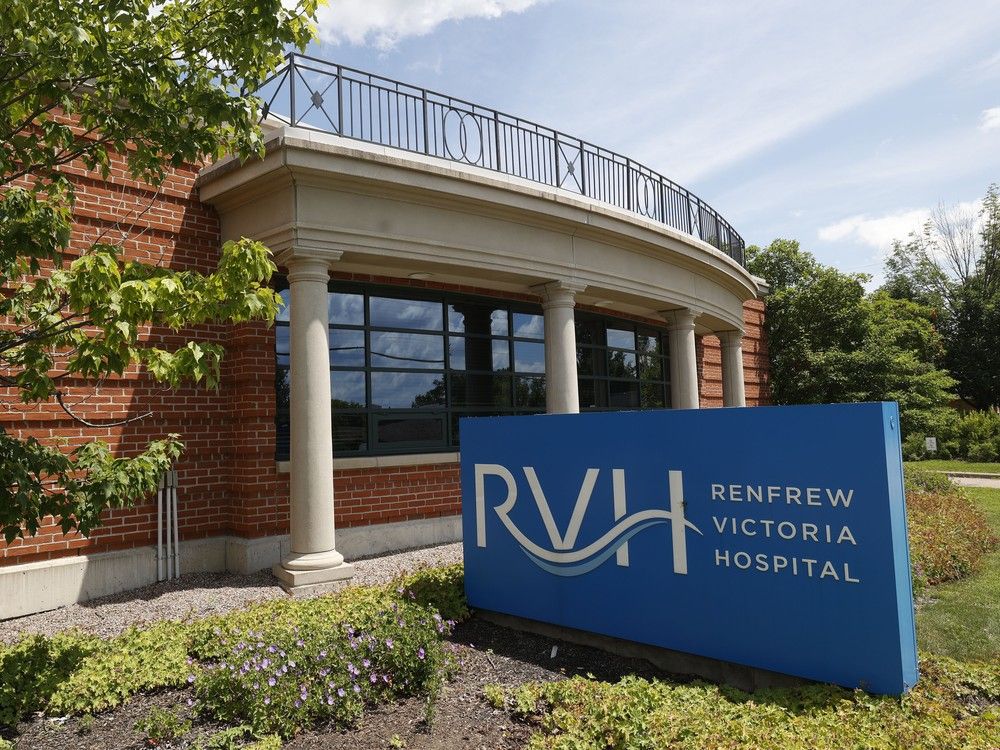
Two former board chairs at Renfrew Victoria Hospital and its foundation are pushing back against a damning report about hospital finances by a provincially-appointed supervisor, saying the boards always followed the advice of lawyers and auditors and did what was best for the hospital and its patients.
Keanan Stone, a former chair of the hospital board, and Jim Lemenchick, former long-time chair of the Renfrew Victoria Hospital Foundation, released a lengthy statement this week defending the creation of Renfrew Health, a not-for-profit organization associated with the hospital that became the focus of a provincial investigation.
They also defended payments to the hospital’s “highly sought after” CEO and senior management team – which was a key focus of a provincial supervisor’s report – saying the funding climate for health care was and still is complex and “we were challenged to retain them. They deserved to be compensated for a job well done and we believe they were never paid more than they deserved.”
According to Canada Revenue Agency records, the Renfrew Victoria Hospital had been quietly transferring millions of dollars in surplus funds to Renfrew Health, a not-for-profit corporation set up by former and current hospital executives and board members.
Meanwhile, for several years, the hospital gave interest-free loans to some employees, according to its annual financial statements.
The OPP’s anti rackets branch is investigating the hospital and Renfrew Health, which is being dissolved. New hospital auditors have been appointed.
Provincial supervisor Altaf Stationwala’s report detailed millions of dollars of irregular and mostly non-transparent financial transactions and practices over three decades, some of which benefitted former hospital executives.
Those transactions included a million dollar interest-free loan to help an unnamed former CEO purchase a property, a $100,000 transitional allowance for the same former CEO, and the improper use of credit cards by some former executives. It also detailed millions of dollars in management fees to former hospital executives that were not made public as part of salary or public expense disclosures. In addition, the former CEO received a second pension, supplementary to his main pension.
The report noted that the hospital under-invested in clinical programs during that period, arguing it had limited financial resources. That included not hiring additional nurses, health providers and security staff.
While it claimed financial strain, the hospital regularly had large surpluses at the end of the year which were not reported as such in its financial statements, said the report.
Between 2014 and 2023, RVH transferred $11.7 million of those surplus funds to Renfrew Health. The hospital foundation also transferred $2.5 million from parking revenue to Renfrew Health.
In their statement, Stone and Lemenchick said the decision to establish Renfrew Health was a “fully informed unanimous decision of both the hospital board and the foundation board,” supported by RVH’s lawyers and auditors and confirmed at a joint meeting of the two boards of directors.
“The purpose of Renfrew Health (RH) was solely to support the activities of Renfrew Victoria Hospital (RVH). The structure and bylaws presented by the Toronto-based legal firm was similar to other comparable organizations in the province. The accounts were audited annually,” the statement said.
The statement also said that non-hospital assets of the hospital, such as a sleep products store and rental properties, were transferred from the hospital to Renfrew Health to allow the hospital and foundation to focus solely on directly related activities and fundraising. Transferring leases reduced any potential liability to the hospital, they wrote.
“We believed this strengthened our governance and sustainability.”
The board chairs noted that RVH grew from a small hospital to one with a “state-of-the-art emergency and ambulatory care centre” with high level programs and nearby buildings housing family doctors who worked in collaboration with the hospital to keep its emergency department open while others were having to temporarily closed over three decades.
“It wasn’t by accident that these things came to be at RVH. Success comes from good planning. Every infrastructure investment, every program enhancement, every penny saved for every major change was strategic, planned out years in advance and executed with expert precision as part of a long-term vision for a best-in-class RVH campus under the guidance of a highly sought-after CEO (and senior management team).”
In an interview, Stone said the two former chairs decided to release the statement because they wanted to try to explain the motivations behind creating Renfrew Health — which Stone said was trying to set the hospital up for success.
“It was all about being able to care for the patients for the long term. In fact that is where all the motivation was always coming back to — the patients and the success and sustainability of the hospital.”
Renfrew Health was created in 2014. Stone was on the hospital board until 2019. Lemenchick stepped down as hospital foundation chair in 2023.
Stone said she met with Stationwala after she requested a meeting and that he didn’t reach out proactively. Stone said he only asked her one question. She didn’t say what that question was.
“When you look at the report he published, we are not sure he even asked all the right questions.”
She said that is one reason they released a statement about the motivations behind creating Renfrew Health.
“It is unfortunate that greater context was not shared surrounding past decisions made by our boards of directors, informed by expert counsel in accountants and lawyers at the time, which has resulted in so much backlash and negativity being stirred up in our community,” the former board chairs wrote in the statement.
They also questioned some of the implications of Stationwala’s report.
Stationwala wrote that he was initially under the impression that “this was a case of a hospital using a related entity (Renfrew Health) for the purposes of bypassing rigorous hospital financial practices, which stood to benefit RVH executives getting paid out of this entity (Renfrew Health).”
Through his research and a financial audit, he wrote that he found Renfrew Health “was just one piece of a larger puzzle pertaining to a series of irregular transactions and practices involving certain former executives.” Some of those practices began at the hospital as early as 1997 and remained in place until recently.
Stationwala said some compensation practices had gone on so long that: “even as new executives came on board as this was understood as the way things were done at Renfrew Victoria Hospital”.
The former chairs’ statement said no major decisions were made at Renfrew Health without the hospital board’s chairman also being involved.
“To imply it was a rogue business or simplistic shell company established solely for the purpose of executive compensation and not integrated with RVH is not correct.”
When the integrity of the situation was initially questioned “it was the directors of Renfrew Health who first suggested folding RH back into RVH and were open to any other arrangements that would allow the businesses of RH to continue to generate positive cash flow to support the continued growth of Renfrew Victoria Hospital.”
In his report, Stationwala emphasized that board members had not breached their fiduciary duties because they sought and obtained legal advice and acted on it.
